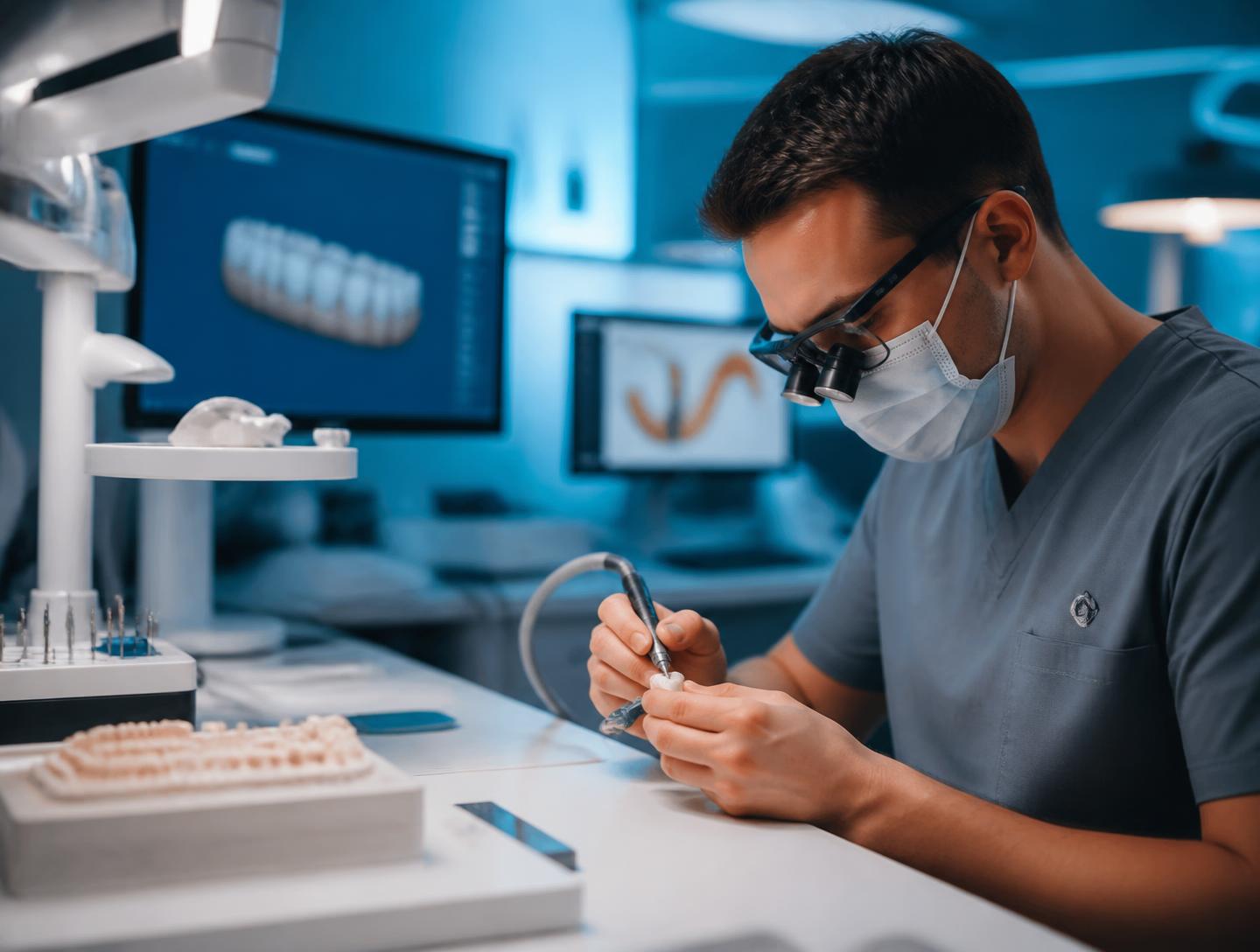
Istar inlay and onlay production

Dental Inlays and Onlays

When a posterior tooth needs more than a filling but does not justify a full crown, you are deciding between two conservative restorations: inlays and onlays. The distinction is mechanical and simple. An inlay sits within the tooth's occlusal surfaces and does not cover any cusp. An onlay extends over at least one cusp, wrapping the tooth like a partial cap and reinforcing it. An overlay covers all cusps.

At Istar Dental Lab, we manufacture inlays and onlays as full-service restoration work — CAD design, milling, sintering, layering, and final inspection handled in our own facilities in Shenzhen and Huizhou, China. This page covers the clinical decision first, then our materials and processes, then the practical details of working with us.

overview — recommended upload 1440 × 960 pixels

Do you need an inlay, an onlay, or a full crown?

This is the first question worth answering, and it is a clinical decision rather than a laboratory one. Our value as a lab is to make that decision easier to execute well once you have made it.

Choosing the right inlay dental restoration — whether an inlay, onlay, or full crown — depends on the extent of tooth damage and the clinical priorities of durability, aesthetics, and conservation. Partial-coverage restorations preserve more healthy tooth structure than a full crown, which is the main clinical argument for them. They are not automatically the better choice, and several conditions work against them.

When an onlay works

  • Sufficient healthy tooth structure remains to provide a durable bond
  • Occlusal space allows for adequate restoration thickness without violating the opposing dentition
  • The tooth's cusps are intact or only partially undermined
  • Parafunction and opposing dentition loads are manageable

When an onlay becomes a poor choice

  • Remaining tooth structure is too limited.

    Once the ferrule effect is compromised, a full crown generally provides better long-term structural support. This is one of the most common reasons a crown is the more predictable choice.
  • Vertical space is insufficient.

    When clearance is tight, the solution shifts toward high-strength materials or space-saving designs rather than a thicker restoration.
  • Endodontically treated teeth with compromised walls.

    Non-vital teeth carry a measurably higher risk of failure in the long-term data, and this deserves careful case selection (Fan et al., 2021).
  • Heavy bruxism or a long-span situation.

    These cases raise the mechanical load and tighten the design margins, so they call for stronger material and more careful thickness planning. It is worth knowing that the evidence on bruxism as a direct cause of ceramic fracture is mixed: a 2021 systematic review found no direct association between parafunctional habits and restoration fracture (Fan et al., 2021). In practice it stays a case-selection caution rather than a proven mechanism.

How do inlays and onlays compare with full crowns in survival?

This is the question where published data most directly answers the concern clinicians raise most often — whether partial coverage restorations fail more than full crowns. The evidence is reassuring, and it is worth examining closely.

A 2018 systematic review that specifically compared inlays and onlays against complete coverage restorations reported mean survival rates of 90.89% for inlays, 93.50% for onlays, and 95.38% for crowns. Across all types, the 5-year survival rate exceeded 90%, and caries was the main biological complication while ceramic fracture was the most common technical complication. The authors noted that study heterogeneity prevented meaningful comparison between restoration types — the figures are pooled means rather than a head-to-head trial (Vagropoulou et al., 2018).

A separate 2016 meta-analysis of ceramic and resin inlays, onlays, and overlays found estimated survival rates for glass-ceramics and feldspathic porcelain between 92% and 95% at 5 years (n = 5,811 restorations) and 91% at 10 years (n = 2,154). In that analysis, fractures and chipping accounted for 4% of failures, followed by endodontic complications at 3%, secondary caries at 1%, and debonding at 1% (Morimoto et al., 2016).

Longer-term data come from a 2021 systematic review of ceramic and composite partial-coverage restorations. It reported survival of ceramic inlays and onlays of 90% at 5 years, 89% at 8 years, and 85% at 10 years, with success rates of 88% at 5 years and 77% at 10 years. Restoration fracture and endodontic complications were the dominant failure modes, while non-vital teeth and multiple-surface restorations tended to raise failure risk (Fan et al., 2021).

The longest mean follow-up among these studies is a practice-based retrospective evaluation of leucite-reinforced glass-ceramic restorations (IPS Empress) followed for 11.2 years on average. Overall survival was 80.3% (inlays 80.4%, onlays 80.0%), and the most frequent complications were ceramic fracture at 10.6% and chipping at 2.3% (Strasding et al., 2020).

One nuance is worth stating honestly: ceramic and resin are not equivalent here. A meta-regression comparing the two found ceramic partial-coverage restorations outperformed resin-based ones at both 5 and 10 years, with 5-year survival of 86% for resin versus 90% for feldspathic porcelain and 92% for glass ceramic. If resin composite is what you plan to use, expect different longevity than the ceramic figures above (Naik et al., 2022).

Our inlay and onlay materials

Material choice is where most of the real decision-making happens. The matrix below maps our available materials against the situations each one handles well.

material-0 — recommended upload 1440 × 960 pixels
Material

E.max (lithium disilicate)

Where it fits
Anterior and premolar inlays; onlays where aesthetics and translucency matter and load is moderate
Considerations
Requires adhesive bonding. Conservative preparation with adequate thickness. We mill from blocks and inspect under dedicated lighting for chipping and cracks after milling.
material-1 — recommended upload 1440 × 960 pixels
Material

Feldspathic porcelain

Where it fits
Cases where a layered build-up and natural translucency are wanted
Considerations
Traditionally cementable; today also milled from blocks. Brittler than glass ceramic in high-load positions.
material-2 — recommended upload 1440 × 960 pixels
Material

Glass ceramic (leucite-reinforced)

Where it fits
Posterior inlays and onlays balancing strength and appearance
Considerations
Good balance of fracture toughness and optical properties. Adhesive protocols available.
material-3 — recommended upload 1440 × 960 pixels
Material

Zirconia (monolithic)

Where it fits
Posterior onlays, bruxism cases, limited vertical space
Considerations
Highest strength in our lineup. Less translucency than glass ceramics. Conventional cementation is generally more appropriate.
material-4 — recommended upload 1440 × 960 pixels
Material

Layered zirconia

Where it fits
Visible surfaces where appearance matters more than in posterior zones
Considerations
Zirconia coping with feldspathic porcelain build-up. Aesthetics best of the zirconia family; requires more reduction.
material-5 — recommended upload 1440 × 960 pixels
Material

Metal-ceramic (PFM)

Where it fits
High load, long spans, posterior zones where strength dominates
Considerations
Still a reasonable choice when durability matters more than aesthetics or where budget is a factor. Risk of porcelain chipping on the ceramic layer.
material-6 — recommended upload 1440 × 960 pixels
Material

Cast metal / gold alloy

Where it fits
Long-span cases, patients with a history of chipping ceramic, bruxism
Considerations
Highest longevity of the lot. Cast rather than milled. Conservative preparation possible because the material is strong in thin sections.

How cementation changes the choice

Bonding method narrows the field, and it is worth deciding early.

  • E.max and veneers are suited to adhesive bonding.
  • Zirconia, PFM, and metal restorations are generally better suited to conventional cementation.

If you are bonding a glass ceramic, the bonding protocol is not optional detail. Lithium disilicate requires hydrofluoric acid etching followed by silanization to achieve a reliable bond. We will flag any preparation design or surface treatment that would compromise adhesion before the case proceeds.

How we manufacture your inlay or onlay

Every case runs in-house. Nothing is outsourced to a third-party lab, which means one team owns the case from data receipt to final inspection.

workflow-0 — recommended upload 1440 × 960 pixels

1. Case receipt and evaluation. We assess the data you send — intraoral scan files or physical impressions — and evaluate the case before production begins.

workflow-1 — recommended upload 1440 × 960 pixels

2. CAD design. Our CAD department designs the restoration digitally. Where a margin design does not suit the chosen material, or where design adjustments would improve outcomes, we contact you through your dedicated WhatsApp group with proposed alternatives rather than proceeding silently.

workflow-2 — recommended upload 1440 × 960 pixels

3. Model production. We 3D print the working models and, for cases requiring it, a diagnostic wax-up or mock-up can be produced first for your approval.

workflow-3 — recommended upload 1440 × 960 pixels

4. CAM milling. Glass ceramics, zirconia, and feldspathic porcelain are milled from blocks.

workflow-4 — recommended upload 1440 × 960 pixels

5. Pressing. Cast ceramics, occlusal splints, and retainers are pressed.

workflow-5 — recommended upload 1440 × 960 pixels

6. Sintering and layering. Zirconia goes through a controlled sintering cycle with locked temperature, ramp rate, and hold time. Porcelain layering and glazing follow.

workflow-6 — recommended upload 1440 × 960 pixels

7. Finishing. Polishing and surface finishing.

workflow-7 — recommended upload 1440 × 960 pixels

8. Quality inspection. Detailed below.

workflow-8 — recommended upload 1440 × 960 pixels

9. Packing and shipment. Restorations are packed in foam-lined boxes to survive transport.

Design approval before production. You can review the design before milling or pressing. If you want changes at that point, tell your case coordinator. One thing to plan for: approved designs extend production by one to two days.

Quality control and inspection

Our quality control is a separate department of approximately 25 staff, not a task folded into production. Roughly 460 people work across the company, including about 100 in CAD design and 70 in milling.

What we check before a restoration leaves

After glazing, we re-verify the restoration

— this step is mandatory, not optional. We check and correct proximal contact, remove occlusal interferences in both centric and excursive paths, and verify marginal fit for any gaps caused by glazing or sintering deformation.

Glass ceramics are inspected under dedicated inspection lighting

after milling, specifically for chipping and cracks.

Fitting problems are diagnosed, not guessed at.

When a restoration will not seat, our technicians identify the interference zone in the design software. When a single crown rotates or the path of insertion is unstable, we examine the abutment form, undercuts, and fit of the restoration.

We compare the finished restoration against your approved design.

Digital restorations can be overlaid against the approved CAD file to check contours, occlusion, contacts, color, and incisal form.

Shipping damage prevention.

Crowns and bridges ship in foam-filled boxes to prevent impact and breakage during transit.

Documentation.

Every case is archived by case number with defect evidence and original design and production records retained.

When something goes wrong

Our process treats root cause, not just replacement.

  • Inspection failures are redone automatically — if a restoration does not pass inspection, it is reworked without waiting for your instruction.
  • Non-conforming material is quarantined and logged. The issue and cause are recorded, rework or scrap is assessed, corrective action is taken, and the ledger is reviewed periodically.
  • Defect analysis separates causes into three buckets: our process, your clinical data, or communication. Individual cases get resolved; recurring defect types trigger a process review that updates standards and adds inspection points.
  • Rework is generally free. Charges apply only in specific circumstances: changes to the original basic requirements, or cases we flagged as problematic beforehand and you asked us to proceed anyway.
  • Issues that pause a case are communicated daily until resolved.

Working with us

Submitting a case

For standard cases we need either a physical impression with an occlusal rim, or intraoral scan data. Digital cases are faster end to end because there is no model to ship and no customs clearance to wait for; physical impressions add cross-border transit time on top of identical bench time.

If you are sending a physical impression internationally:

  • Alginate is not suitable for international shipping. It contains water, dehydrates and shrinks, can mold, and carries customs quarantine risk. Send VPS or polyether instead.
  • Check before shipping: no damage or bubbles, intact margins, rinsed and dried, tray secured, packed against compression and heat, and labels matching the prescription.

If you are sending digital data, send it by email or your data transfer platform.

References are welcome. We accept sketches, photos of the existing restoration, diagnostic wax-ups, and temporary restorations as guides. We can also mirror or copy morphology from an existing crown or from the contralateral tooth.

case-submission — recommended upload 1440 × 960 pixels

Turnaround time

Standard laboratory production is 2–3 working days, calculated in working days from the day we receive the case.

What does not count against that clock: design approval waits, missing information being supplied, and time spent waiting for your reply. The clock restarts once we have complete information or your confirmation.

Also worth planning around:

  • Chinese public holidays and weekends are not production or shipping days. Scheduling extends accordingly; we still receive messages, but responses are slower.
  • Rush cases are available and can be arranged before or after submission. Rush handling below ten cases per month carries no additional charge. A specific arrival date can be committed to.
  • Delays caused by technical questions or a rescan are treated as rush cases — the timing works accordingly.
  • You are notified at design completion, production completion, and dispatch, with the courier tracking number included.
digital-scanning — recommended upload 1440 × 960 pixels

Digital scanning guidance

Long-span and full-arch cases accumulate stitching error. To minimize it:

  • Scan continuously in one direction with adequate overlap (30% or more)
  • Use stable anatomical landmarks such as cusps as registration points
  • Keep head position fixed; use isolation to control noise
  • Capture the centric occlusion record in one complete pass
  • Inspect stitching steps as soon as the scan completes and rescan immediately if misregistration appears

Full-arch cases are particularly prone to cross-arch error because edentulous areas lack natural tooth references and saliva and soft tissue interference cause software registration drift. Verification jigs can be used to check accuracy.

Communication

Every account has a designated manager and customer service team, on a fixed communication channel. Email, WhatsApp, and video meetings are all available, and we can hold technical case conferences in English.

Standard customer service hours are 9:30 am to 6:00 pm, extendable to midnight for special cases. Managers accommodate urgent cases outside those hours.

For feedback during try-in, we establish a WhatsApp group with a dedicated contact so trial feedback is written back into the final design.

Material traceability and compliance

  • Material batch number, brand, country of origin, and certificates of conformity are available per case, on request for your review.
  • Documentation can be provided in English, including custom declarations, material certificates, and product labels.
  • Regulatory requirements are confirmed before accepting the case, based on the delivery destination. Materials, labels, and certificates are prepared for the destination country's standards. Where requirements conflict, we discuss this with you in advance and archive the assessment.
  • Your brand is an option. Packaging, prescriptions, labels, and communication can all be presented without Istar branding.

Shipping

Shipments go out through Istar's factory courier account, with access to factory bulk rate agreements. Outbound shipping is at your cost; for return shipments, the factory covers costs above a certain package value, and a portion is charged to the customer below that threshold.

Tracking numbers and estimated arrival times are provided on the dispatch day, and package follow-up is actively monitored until delivery. Shipping insurance is not included by default and can be purchased; the maximum claim covers processing fees or the insured value, not consequential loss.

If you need to change a delivery address, it can be done urgently before packing. Once shipped, we cannot intercept it — you will need to contact the carrier.

Splitting orders is possible before machining begins at the design stage. After milling or sintering, splitting generally is not possible and adds labor and shipping cost requiring approval.

Factory visits

We welcome visits to Shenzhen and Huizhou. Clinics, labs, and partners can arrange factory visits, production line tours, video factory inspections, and manufacturing capability discussions, so you can see the workflow and quality procedures directly.

factory-visit — recommended upload 1440 × 960 pixels

Capacity

Normal season: approximately 8,000 zirconia single crowns, 2,000 zirconia bridges, 20 All-on-X arches, and 4,000 removable dentures per month. Peak season roughly doubles this: 15,000 crowns, 3,000 bridges, 40 arches, and 6,500 dentures.

We maintain approximately 50 trained backup workers for peak season support. If a sudden large order would affect existing cases, we prioritize already-confirmed schedules, and negotiate split shipments or adjusted delivery dates for new orders rather than compressing quality standards. If production is disrupted by equipment failure or material shortage, we contact you proactively with the reason, estimated delay, and alternatives.

Frequently asked questions

How long do inlays and onlays last?

Ceramic partial-coverage restorations show survival rates of 92–95% at 5 years and about 91% at 10 years in pooled data. Onlays specifically report around 93.5%. Individual longevity depends heavily on the tooth's condition, the material, bonding quality, and the patient's parafunctional habits. Gold restorations are the longest-lasting option when they are appropriate.

Are inlays and onlays a better choice than crowns?

They preserve more healthy tooth structure, which is their main advantage. They are not automatically better — when remaining tooth structure is limited, a crown is usually the more predictable choice. Survival rates for onlays and crowns are closer than often assumed, with pooled figures of 93.5% and 95.4% respectively.

What causes inlays and onlays to fail?

Fractures and chipping are the leading cause, followed by endodontic complications, secondary caries, and debonding. Most of these trace back to preparation design, material choice, bonding quality, and occlusal load rather than to the restoration type itself. This is the area where careful preparation and design practice has the most effect.

Can an inlay or onlay be done in a single visit?

With current chairside CAD/CAM this is sometimes possible, and some restorations are delivered same-day. It is not universally available, and the conditions for a one-visit workflow are specific — adequate digital data, sufficient time, and a clinical situation compatible with immediate fabrication. For cases we handle, standard production is 2–3 working days.

How is the color matched for anterior restorations?

Shade selection involves layering rather than relying on a single shade tab. We recommend photos or video of the shade taken in natural light with the tooth clean and moist, ideally showing the natural tooth alongside a shade guide, plus the prepared tooth alongside a shade guide. This lets us judge whether masking is required and shade the restoration accurately against its neighbors. For multiple restorations on the same patient, we record and archive contour and morphology to keep them consistent.

What information do you need from me to start?

Either a physical impression with an occlusal rim, or intraoral scan data. For anterior cases, shade photographs help considerably. References such as existing restorations, photos, wax-ups, or a temporary restoration are welcome and often useful.

How do I get a price?

Contact the sales manager for the B2B price list. Standard pricing logic is unit count as the base, material setting the baseline, with implant components and design complexity as additions. Design, models, components, packaging, and shipping are included in the quoted price.

Why is my case on hold?

Cases pause when information is incomplete or a technical question needs your input — a margin design unsuited to the material, a scan issue, or a missing reference. Your coordinator contacts you and notifies daily until the issue is resolved. The turnaround clock restarts once complete information is received.

Do you handle rush cases?

Yes. Rush handling can be arranged before or after case submission, applies to all materials and case types, and carries no additional charge when volume is under ten cases per month. A specific arrival date can be committed.

Start a case

The fastest way to find out whether we fit your workflow is to send one trial case. Send digital data by email or your transfer platform, or a physical impression by courier, and tell us the material and the case details. If you would rather start with a conversation, ask your sales manager for the B2B price list and material list, or request a technical case conference in English.

Want to get in touch directly? Reach out to our sales representative via WhatsApp at +8618925410015 for a quick response and a price quote!

Sources

  1. Vagropoulou GI, Klifopoulou GL, Vlahou SG, Hirayama H, Michalakis K. Complications and survival rates of inlays and onlays vs complete coverage restorations: A systematic review and analysis of studies. Journal of Oral Rehabilitation, 2018;45(11):903–920.
  2. Morimoto S, Rebello de Sampaio FB, Braga MM, Sesma N, Özcan M. Survival Rate of Resin and Ceramic Inlays, Onlays, and Overlays: A Systematic Review and Meta-analysis. Journal of Dental Research, 2016;95(9):985–994.
  3. Strasding M, Sebestyén-Hüvös E, Studer S, Lehner C, Jung RE, Sailer I. Long-term outcomes of all-ceramic inlays and onlays after a mean observation time of 11 years. Quintessence International, 2020;51(7):566–576.
  4. Naik VB, Jain AK, Rao RD, Naik BD. Comparative evaluation of clinical performance of ceramic and resin inlays, onlays, and overlays: A systematic review and meta analysis. Journal of Conservative Dentistry, 2022;25(4):347–355.