
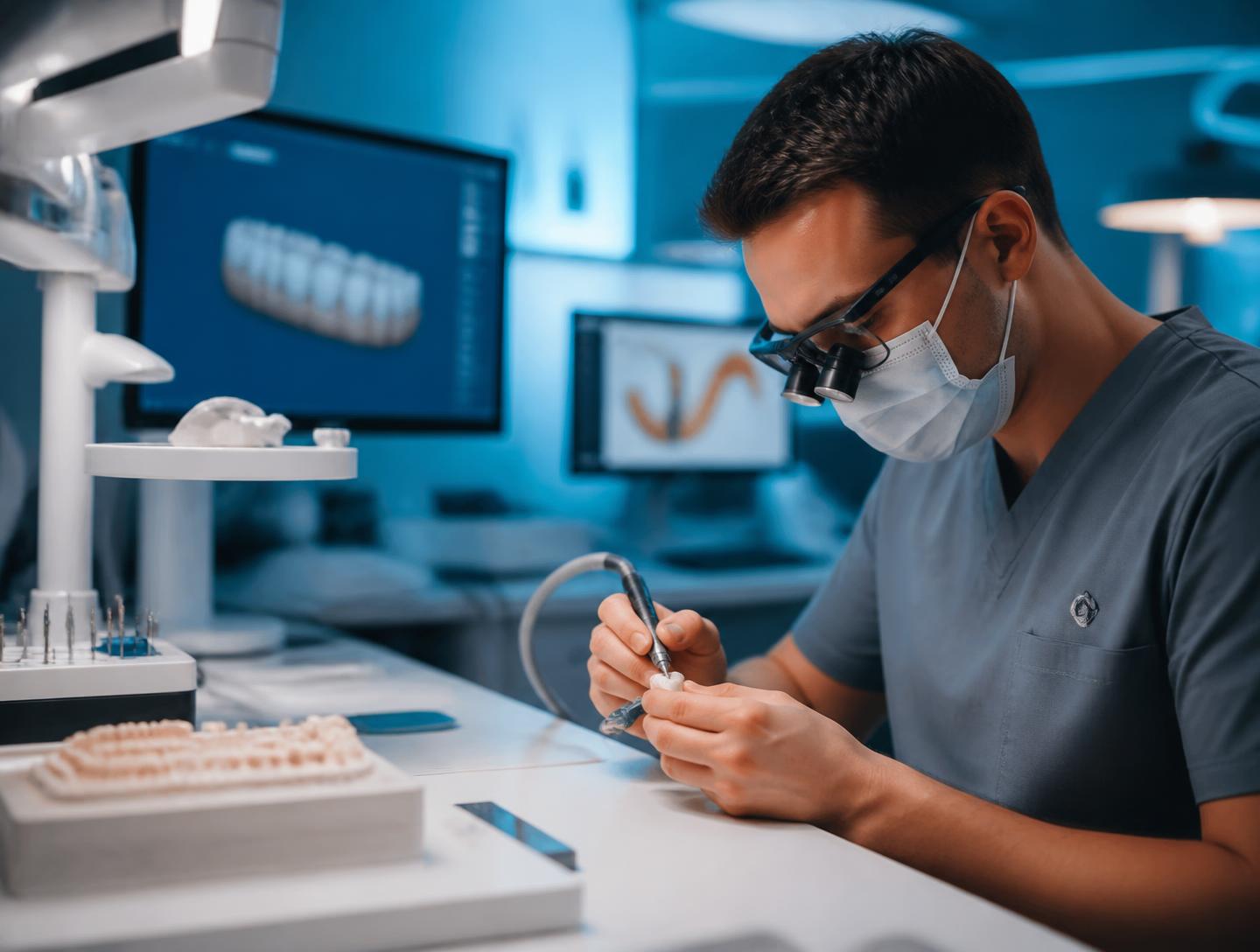
Istar night guard dental laboratory

Night Guard Dental Lab — Custom Occlusal Splints Built In-House

Night guard cases don't usually fail at the chair — they fail somewhere between the Rx and the finished appliance. The material wasn't what was prescribed. The thickness isn't labeled on arrival. The remake lands in a queue no one can trace. The common thread is that no one owned the case end to end.

Istar Dental Lab is a full-service night guard dental lab founded in 2012, building custom hard, soft, and dual-laminate occlusal splints at our two facilities in Shenzhen and Huizhou. Every stage — digital design, model, thermoforming, trim, QC, packaging — runs through our own 460 technicians under an FDA / MDR / MHRA / ISO 13485 quality system. Each case ships with a per-case audit chain back to the technician, machine, material batch, and QC record. Nothing routed outside.

Which guard fits which case

Not every intraoral splint is a night guard, and the terminology travels badly between offices. We build three occlusal appliance categories, separated by what sits against the opposing teeth.

1440 × 960Hard occlusal splint (acrylic) · Recommended upload size · px

Hard occlusal splint (acrylic)

Occlusal surface. Hard, flat, and adjustable.

Where it fits. Heavier parafunction and documented occlusal wear. Cases where the dentist wants a flat, adjustable scheme to study occlusion or support a TMD evaluation. Bite splints prescribed as part of a restorative plan.

Where it does not. Replacing a mandibular advancement device for sleep apnea — that is a separate device class. Patients who cannot tolerate full acrylic even after reasonable adjustment.

1440 × 960Soft night guard · Recommended upload size · px

Soft night guard

Occlusal surface. Soft, cushioning.

Where it fits. Mild clenching and light grinding. Patients who need to acclimate before moving to acrylic. Cases with undercuts, missing teeth, or an unusual draw path — a hard blank will not seat on those arches, soft material can.

Where it does not. Heavier grinders. Soft material gets chewed through quickly and the remake cycle gets expensive on both sides.

1440 × 960Dual-laminate guard · Recommended upload size · px

Dual-laminate guard

Occlusal surface. Hard outer, soft inner.

Where it fits. Patients who need an even hard occlusal contact but cannot wear full acrylic comfortably. Overflow between the Hard and Soft indications where you want to split the difference without compromising the biting surface.

Where it does not. Thin-cross-section cases where a laminate adds too much vertical height.

How a case moves through the lab

  1. 1. Intake

    Digital Rx. Open exports from TRIOS (.3oxz, STL/PLY), iTero (STL/PLY from MyiTero — not the encrypted packet), Medit (native, STL/PLY/OBJ), CEREC/Sirona (STL/PLY — not DXD/RST), Planmeca, and Shining3D Aoralscan.

    Physical Rx. Upper and lower impressions plus a PVS/VPS or polyether bite registration. Wax is discouraged — it deforms during international shipping.

    Rx fields we need. Appliance type, arch, thickness, coverage, color, and anything unusual (existing crowns on preparation teeth, undercuts to preserve, planned restorations, material allergies).

    Patient ID. A clinic case number is enough; patient names are optional and we encourage coded identifiers.

    Validation window. One business day. If the scan or bite is unusable, we flag it the same day and name what to re-scan.

  2. 2. Design review

    Articulation. Models are re-articulated and the intercuspal position is verified against the submitted bite record.

    Therapeutic positions. For repositioning splints, the Rx must specify the target position with a protrusive or constructive bite record.

    Approval gate. Design approval is required for occlusal reconstruction, full-arch coverage with a modified occlusal scheme, or any unusual retention requirement. Simpler single-arch guards move straight to production.

  3. 3. Thermoforming

    Model. A printed working model is produced from the scan or impression.

    Decision authority. Thickness and hardness are the dentist's call — we manufacture to the Rx. Common night guard sheet stock sits in the 2–4mm range; values outside that are confirmed for availability before cutting.

    Substitutions. Any material substitution on our side (stock, supplier batch) requires written sign-off before production begins.

    Process control. Heating, pressure, and cooling are controlled through the full cycle to limit shrinkage and surface defects. Dual-laminate layers are fused before trimming.

  4. 4. Trim, QC, and shipment

    Trim. Buccal/labial coverage to the mucogingival junction unless the Rx specifies otherwise; palatal relief where indicated; no sharp edges at the retromolar pad.

    QC checks. Caliper thickness at multiple points against the prescribed value (measured value written on the case card); edge inspection for burrs and asymmetric extensions; seat/release test on the model; visual inspection for cracks and air pockets.

    QC fails. Remade automatically — the clinic is not asked.

    Pre-ship photos. Appliance on model, trim close-up, caliper reading. Attached to the shipping notification on request at no extra charge.

    Packaging. Sealed per case with clinic, case number, and patient reference. Multiple cases to the same clinic consolidate into one parcel.

    Carriers. DHL, FedEx, UPS, or SPIDER (France).

Have a specific case? Send the Rx and scan to [[email protected]] and we confirm receipt the same business day.

Turnaround and remakes

Turnaround

In-lab production for a thermoformed splint is short, and the specific day count is confirmed at quoting — it depends on material, laminate structure, and model type. For context on adjacent product lines, standard crown-and-bridge runs 2–3 working days in-lab and complex implant or full-arch cases run 5–7.

All times are working days from the day we receive a complete case. Client review windows, scan retakes, and missing-information holds do not count. Weekends, Chinese public holidays, and Chinese New Year sit outside the clock and are communicated in advance during peak periods.

Rush is available on any case type and in most situations carries no added lab fee. It can be requested before or alongside the case, and we confirm a target delivery date on acceptance. Rush compresses in-lab time — it does not shorten the courier transit window, and we are explicit about that at quoting so the delivery date committed to the patient is realistic.

Acceptance on arrival

For a splint or night guard, the arrival checks are thickness at multiple points, edge extension and smoothness, and retention on the model. Small chair-side adjustments that stay within those parameters and preserve retention and occlusion count as in-office work. Anything that compromises them — poor fit, missing retention, wrong occlusal surface, warped or shrunk material — comes back to us.

Remake policy

Issue on our side: free remake, including return shipping once the parcel value crosses the threshold set per account. No warranty window — if the defect left our bench, it is ours regardless of when it surfaces.

Request changes the original Rx, or the case was flagged as unclear and the clinic asked us to proceed anyway: quoted separately before any new work begins.

Traceability: each case ties back to a specific technician, machine, material batch, thermoforming parameters, and QC entry. If something fails downstream, we walk back through the chain and name where it broke.

Compliance and reporting

Lab-side registrations: FDA, MDR (via our EU authorized representative — custom-made Class IIa dental devices are notified under Annex XIII), MHRA (UK), and ISO 13485 for the quality system. The sheet materials themselves carry CE marks and biocompatibility certification under ISO 10993 from the raw-material manufacturer. Batch number, material brand, origin, and certificates of conformity are issued per case on request.

In the US, prescription occlusal guards sit under FDA product codes MQC (prescription) and OBR (OTC). Both are pre-amendment, unclassified devices. FDA does not approve bruxism or TMJ indications for these codes — our registration confirms us as a listed manufacturer, not that FDA endorsed a therapeutic claim.

Starting a first case

Three steps for a new account:

  1. Send the Rx and the scan or impression details to sales — email or the inquiry form below.

  2. We confirm receipt the same business day, flag anything missing, and send a quote.

  3. On approval, the case enters production.

If you are evaluating us as a supplier, a short note about current volume, the appliance types you prescribe most, and the scanner(s) in your clinic is enough for us to send a sample Rx template and schedule a video walk-through of one of your own case types.

For a dental lab mouth guard quote, a direct night guard dental lab contract, or a single trial case, send scans or photos of a current case to [[email protected]]. Replies go out the same business day during China working hours; cases received after local close enter the queue the next working morning.

Want to get in touch directly? Reach out to our sales representative via WhatsApp at +8618925410015 for a quick response and a price quote!

FAQ

Do you take on overflow production for partner labs?

Yes. Existing customers include 50+ dental laboratories, 100+ clinics, and 400+ dentists cumulatively. We can act as the production arm behind another lab under that lab's brand, with case cards and packaging prepared accordingly. NDAs are signed on request.

What about shipping loss or damage?

International parcels default to no insurance; paid insurance per shipment is available with standard carrier coverage. Our liability caps at the lab fee or declared insured value and does not extend to indirect losses. Damaged arrivals are remade at no charge.

Who owns the scans and the design files?

The clinic and the prescribing dentist. Original patient data, scans, and files supplied by the clinic remain the clinic's property. We hold a working copy only to produce the case, and we do not use case files to train software or for any purpose outside the specific case.

Can we communicate on WhatsApp or set up a dedicated case group?

Yes. For higher-volume accounts we set up a dedicated group chat with a case coordinator. Email and video calls work the same way — whichever your team already uses.