
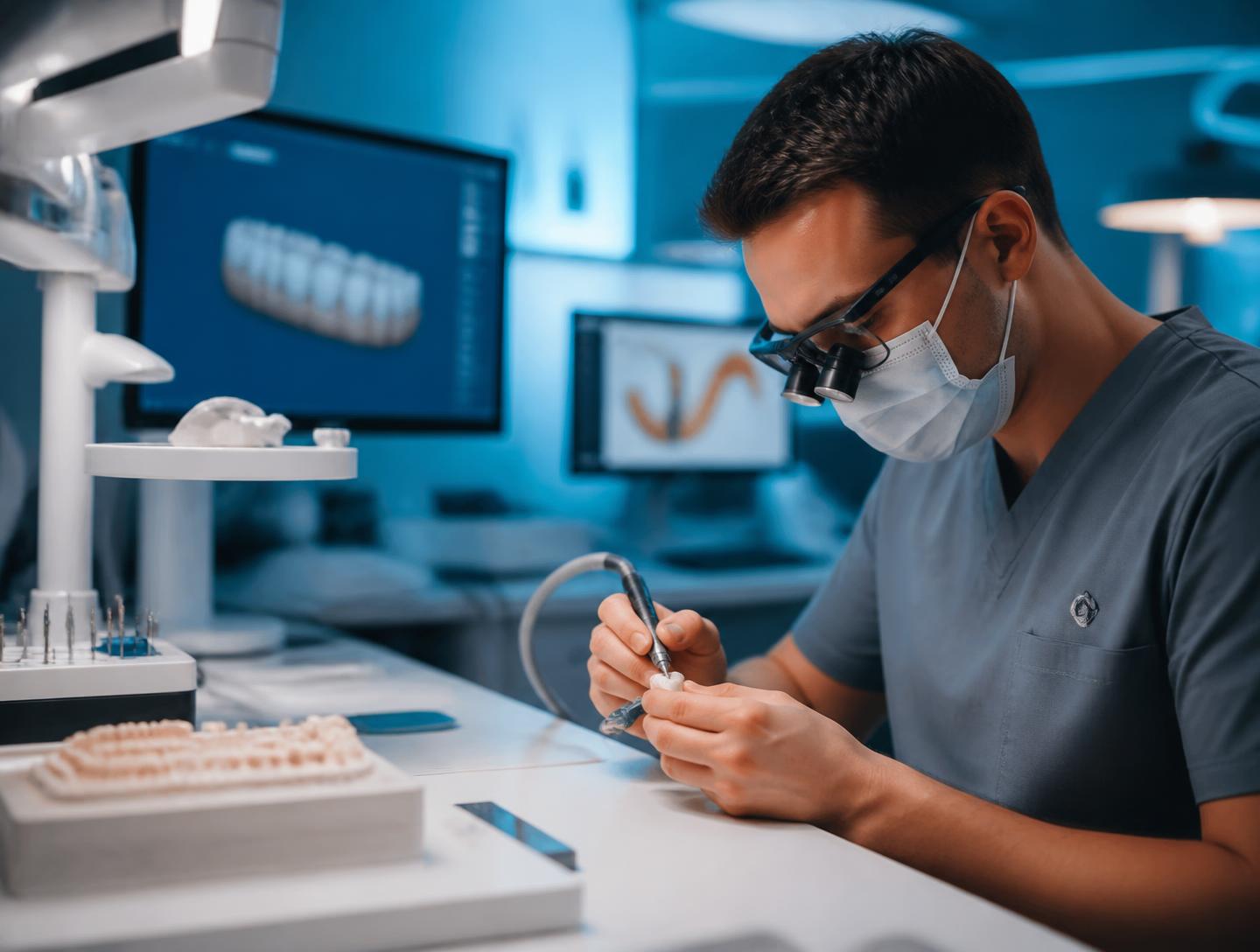
Istar orthodontic laboratory

Orthodontic Laboratory: Retainers, Splints, and Model Work from a Direct Factory

A full-service orthodontic laboratory for clinics, orthodontic practices, DSOs, and dental labs that outsource retention and splint volume. Standard Hawley, clear vacuum-formed, and bonded lingual retainers ship from our Shenzhen and Huizhou facility in 2–3 working days of in-lab build, under a written remake policy, with CAD design, model printing, thermoforming, wire bending, acrylic processing, and QC completed on one floor — no outsourcing of any orthodontic laboratory step to a third party.

What We Build

1440 × 960Hawley retainer · Recommended upload size · px

Hawley retainer — PMMA baseplate with a stainless-steel labial bow and the clasp configuration your Rx specifies. Baseplate thickness, bow curvature, and clasp placement follow the prescription. Pediatric color and pattern options available on request. Suitable as a long-term retention appliance after fixed appliance or clear aligner treatment.

1440 × 960Clear vacuum-formed retainer (Essix-style) · Recommended upload size · px

Clear vacuum-formed retainer (Essix-style) — Thermoformed from medical-grade sheet material. Default sheet thickness is 1 mm (finished occlusal thickness around 0.7 mm). Trim line defaults to 1–2 mm below the free gingival margin; full-coverage and scalloped trims available if specified. Common for post-treatment retention when esthetics matter.

1440 × 960Bonded lingual retainer with indirect transfer tray · Recommended upload size · px

Bonded lingual retainer with indirect transfer tray — Fixed retention wire contoured to the lingual surfaces of the specified teeth (3-3, 4-4, or 5-5). Braided multi-strand or single-strand round wire per Rx. The transfer tray is built on the model so the full wire seats in a single controlled motion at chairside.

1440 × 960Hard full-coverage occlusal splint · Recommended upload size · px

Hard full-coverage occlusal splint — Rigid acrylic or thermoformed hard sheet for bruxism and TMD cases where cushioning would collapse under load. Occlusal contact pattern verified on an articulator against the bite record you shipped.

1440 × 960Soft night guard · Recommended upload size · px

Soft night guard — Single-layer soft sheet for mild bruxism and athletic trauma protection.

1440 × 960Dual-laminate hard-soft night guard · Recommended upload size · px

Dual-laminate hard-soft night guard — Soft inner for comfort, hard outer for longevity. Often requested when a single-layer soft guard wears through too quickly.

1440 × 960Periodontal splint · Recommended upload size · px

Periodontal splint — For mobility stabilization. Material and extent follow Rx.

Our Manufacturing Capabilities

What makes a retainer or splint fit well isn't the product category — it's what happens at each station on the floor. The orthodontic laboratory capability stack below runs under one roof, grouped by workflow.

CAD and digital design

Open-workflow STL / PLY / OBJ accepted from any scanner on the digital intake list. Scan files import into our CAD environment where the working model is prepared, bracket geometry handled per your Rx, trim lines drawn, and wire paths planned before anything goes to the floor. For teams running a mixed digital-and-physical intake, physical impressions are poured in dental stone and scanned to join the same digital pipeline.

3D printing

Biocompatible dental resins printed on calibrated machines, kept physically separate from any non-medical resin lines to avoid cross-contamination. Test coupons printed and dimension-checked regularly to confirm printer calibration. Printing covers working models, diagnostic wax-ups, surgical model work, and the base layer for Hawley appliances built on a printed foundation.

Thermoforming

Vacuum and pressure forming stations run on controlled heating, stable press, and slow cool-down under pressure until the material fully sets. Rushing the cool-down is the usual cause of a piece that fits on the model but distorts on the mouth. Formlabs' thermoformed retainer and aligner guide documents the physics — a 1 mm sheet thermoformed over a working model finishes at roughly 0.7 mm at the occlusal surface, with the finished thickness thinning further as model height increases. This behavior is sheet-independent and we design the trim line around it.

Wire bending and framework

Labial bows, clasps, retention wires, and framework components are formed to the model and verified for passive seating before any acrylic or carrier material goes down. Wire selection — gauge, temper, braided vs single-strand — follows your Rx. Transfer trays for bonded lingual retainers are built on the working model so the wire can be seated chairside in one controlled motion.

Acrylic processing

Dental-grade PMMA mixed and poured or pressed to the thickness your Rx specifies, polymerized under controlled cure cycle to minimize voids and bubbles. The cure cycle is the lever that determines surface quality and stress distribution — pulling a piece early traps monomer; running it too hot stresses the matrix.

Finishing, trimming, and polishing

Trim lines cut manually under magnification, then polished to a smooth finish. An under-polished acrylic surface collects biofilm; an over-trimmed baseplate loses retention. Both show up in QC and get rework slots before the piece leaves the floor. Trim profiles on clear retainers follow Rx — default is 1–2 mm below the free gingival margin, with full-coverage and scalloped options on request.

Capacity

Peak-season monthly capacity across the full product line sits at approximately 15,000 single crowns, 3,000 bridges, 40 All-on-X arches, and 6,500 removable units, with 50 trained backup workers held for peak absorption. Orthodontic retention and splint volume runs as a dedicated subset of that capacity, which is how we hold 2–3 working days even in peak months.

Quality Control and Traceability

Every unit goes through a dedicated QC station before packaging. For retainers and splints, the pass criteria are:

CheckStandard
ThicknessMeasured at multiple points with calipers, within the Rx tolerance
MarginSmooth, continuous, no burrs or lifted edges, model-adapted
RetentionSeats and releases cleanly on the stone model, no rocking or forcing
SurfaceNo visible cracks or trapped bubbles under inspection lighting
Occlusion (splints)Articulator contact pattern matches the bite record

A piece that fails any of the five goes back to production before it leaves the orthodontic laboratory floor. Our first-pass QC rate — the share of cases that pass final inspection without in-house rework — runs around 95%. That figure is an internal operations metric, not a clinical outcome study, and we're happy to walk through how it's calculated on a factory audit call.

Per case, we hold the material batch and brand, the technician at each production stage, the equipment ID, the QC record, and any Rx confirmations we exchanged with you. Default retention is 3 months; longer on request.

Facility certifications on the lab side are ISO 13485 for the quality system. Material biocompatibility documentation (ISO 10993) and CE marking paperwork come from suppliers and are available with the shipment on request. US-destined work is moving to the Quality Management System Regulation (QMSR), which incorporates ISO 13485:2016 and takes effect February 2, 2026.

Facility visits are available at both Shenzhen and Huizhou by appointment, in person or by scheduled video walkthrough.

Remake Policy

Factory-defect remakes are rebuilt at no charge — this covers pieces that don't seat, margins that lift, clasps that don't match the Rx, wrong color or material, visible defects, and splints whose occlusal contact doesn't match the bite record. Report within 24 hours of delivery with case number and a photo.

The covered-condition list, 24-hour reporting window, return-freight threshold, and what qualifies as a new case vs a remake are all documented on our Remake Policy page.

Orthodontic Retainer Lab Turnaround and Shipping

In-lab build time, from the day a complete case is logged:

Case typeIn-lab working days
Hawley, clear vacuum-formed, or bonded lingual retainer2–3
Occlusal splint or night guard2–3
Multi-stage case (multiple appliances in sequence, full-arch coverage)5–7

International transit via DHL, FedEx, or UPS typically adds 1 to 3 business days to US and Western European destinations once the package is in the courier network. Customs clearance adds 0 to 2 depending on destination and declared value — we quote the lab build days separately from transit because the transit side is not under our control.

Rush slots are reserved daily. For small-volume rush requests (fewer than roughly 10 units per month flagged as rush), no surcharge applies — send the case with "rush" in the subject line and we confirm feasibility the same business day.

Outbound freight (your side to ours) is on your account. Return freight on factory-defect remakes above threshold is on ours.

Digital Workflow

1440 × 960Digital retainer design and model preparation · Recommended upload size · px

Scanners we accept directly: 3Shape TRIOS, iTero, Medit (i500 / i700 / i900), Dentsply Sirona CEREC Primescan and Omnicam, Shining 3D Aoralscan, and Planmeca Emerald. Any other scanner that exports open STL, PLY, or OBJ files works too — send one case and we tell you whether the file opens cleanly. The digital intake share for US labs is above 80% of received impressions per the LMT Magazine 2025 survey, so sending digital is the default we optimize for.

Physical impressions we accept: VPS (addition silicone, preferred for international transit), polyether, condensation silicone, poured stone models, and printed resin models. Alginate does not survive international shipping, so we don't accept it.

Send a Case

The quickest way to evaluate us as a full-service orthodontic dental laboratory is one real case. A Hawley, a clear retainer, or a night guard is enough to see how records intake, build quality, and shipping compare against your current standard.

For a written quote within one business day, send the case brief through our contact form. Response the same business day.

For a factory tour at Shenzhen or Huizhou, in person or over scheduled video, tell us when you'd like to visit.

For a technical conversation first — unusual appliance, complex case, multi-location coordination — reach the technical team and we'll set up a call with whoever on the floor actually builds the piece.

Want to get in touch directly? Reach out to our sales representative via WhatsApp at +8618925410015 for a quick response and a price quote!

FAQ

What's the lead time on an orthodontic retainer lab order?

2–3 working days in-lab for standard retention and splint work, 5–7 for multi-stage cases, plus courier transit on top. The clock starts the day the complete case is logged.

Do you supply the compliance paperwork with the shipment?

Yes on request — material batch and brand per case, ISO 13485 scope documentation for the facility, and biocompatibility documentation from the material supplier side. Tell your account manager at order time.

Who signs the custom-made device declaration?

For EU shipments we issue the custom-made device declaration under the MDR framework through our EU authorized representative. US side follows FDA custom device exemption guidance.

Can I keep the STL file after the case ships?

Yes. Ask your account manager to include the export with the shipment, or request it after delivery.

Do you work with DSOs and group practices?

Yes. DSO, group practice, and lab-to-lab accounts typically run on a dedicated channel (WhatsApp, WeCom, or scheduled calls) with monthly billing.

What's the retention evidence base?

The 2023 Cochrane systematic review on orthodontic retention covered 47 studies and 4,377 participants and concluded that the certainty of evidence is low to very low — not enough to rank one retention regimen above another. Our role as a full-service orthodontic dental laboratory is to build the appliance you prescribe to the specification you set, not to recommend a retention protocol.