Istar metal crown production

Full Cast Metal Crowns — Alloy Options, Prep Window, and Lab Workflow

Full Cast Metal Crowns are single-piece metal restorations with no ceramic veneer. Because there is no porcelain layer, the restoration can be made thinner than a PFM, which matters when you have a short clinical crown, limited occlusal clearance, or a bruxer who keeps breaking ceramics. At Istar Dental Lab we cast and mill them in-house, from CAD design through final polish and QC. This page is written for the dentist, the clinic owner, the DSO procurement lead, and the outsourcing lab who needs to know exactly what we can do, under what prep window, in what alloy, in how many business days, and under what remake policy.

overview — recommended upload 1440 × 960 pixels

When a Full Cast Metal Crown is the right call

A full-metal design is the quietest choice when esthetics is not the primary constraint. The real decision happens on four axes:

  • Position. Second molars and non-display first molars are the typical home. Anterior or display-zone premolars are not what this restoration is for.
  • Remaining tooth structure. Short, over-tapered, or heavily restored abutments benefit from the fact that a cast metal retainer can be made with less occlusal and axial reduction than a layered ceramic. Cusp-protective designs on bruxers also fit here.
  • Occlusal space. When you can only promise 1.0–1.5 mm of clearance, a monolithic metal occlusal surface works. When clearance is marginal we can also finish a PFM with a metal occlusal surface — tell us at Rx stage and we will design accordingly.
  • Patient factors. Known gold or palladium allergy pushes you to a different alloy class, not a different restoration category; a confirmed, patch-test-positive reaction to the specific component in your preferred alloy is a reason to switch material rather than cancel the case.

What it is not the right call for:

  • Smile-line visibility that the patient has flagged as a concern.
  • A case where a conservative onlay would restore function without full coverage. Full-cast is the most conservative choice inside the full-crown family (no veneer thickness to accommodate), but it still removes more tooth than a partial-coverage restoration.
  • A patient with a documented contact allergy to a component that is in every alloy class you can offer. In that specific case the honest answer is to re-plan with the restorative dentist.

Preparation window we work to

The numbers below are the clinical-teaching values we use when checking an incoming case, cross-referenced to standard operative dentistry teaching. If your prep is tighter than this on one axis, tell us at Rx submission so we can confirm whether we can still deliver an acceptable restoration or whether a re-prep is faster than a remake.

DimensionTargetWhy we flag it
Functional cusp reduction1.5 mmBelow this the metal thickness drops into deformation territory under heavy load
Non-functional cusp reduction1.0 mmNeeded for occlusal thickness without a hollow
Axial reduction1.0 mm at marginal ridge, 0.6 mm at cervicalToo little and we cannot cast a cleansable contour
Margin designChamfer or light shoulder, 0.5 mm metal collarKnife-edge margins are the single most common cause of fit disputes we see from scanned prep data
Total occlusal convergence~6° per wallOver-tapered walls lose retention; parallel walls will not seat
Functional cusp bevel~45°Protects the metal from thin, chipping edges along the occlusal line angle
Margin locationSupragingival where esthetics allowsReliable scan/impression capture; easier post-cementation hygiene
preparation — recommended upload 1440 × 960 pixels

Opposing-tooth wear

In a 2024 systematic review and network meta-analysis of 261 crowns across 177 subjects with up to 24 months of follow-up, mean antagonist enamel loss versus natural-tooth controls was +82.5 µm opposing metal-ceramic, +40.1 µm opposing monolithic zirconia, and +5.0 µm opposing lithium disilicate (Mao et al., Journal of Dentistry). The review did not break out full cast metal as a separate arm, so we cannot quote a direct number for it. The biological rationale that polished high-noble gold is kind to opposing enamel is well established, but a quantified head-to-head value for cast gold against modern ceramics is not available in the current peer-reviewed literature we have found. If a specific µm value matters for your case documentation, ask us and we will share what we have.

Alloys we cast and mill

We offer four alloy groups across the three ADA tiers, as defined by the ADA's materials classification (Materials for Indirect Restorations). The choice is driven by biocompatibility history, mechanical demand, and budget — color follows composition, not the other way around.

alloy-0 — recommended upload 1440 × 960 pixels
ADA tier

High Noble (≥60% noble, ≥40% gold)

What we cast
Gold-based casting alloys; platinum-containing alloys
Typical application
First-choice retainer for bruxers, long-span bridges, patients with Ni/base-metal history
Color
Yellow or white (platinum-containing alloys are white)
alloy-1 — recommended upload 1440 × 960 pixels
ADA tier

Noble (≥25% noble)

What we cast
Palladium-silver alloys
Typical application
Price-sensitive cases where a predominantly base alloy is not acceptable
Color
Silver-gray
alloy-2 — recommended upload 1440 × 960 pixels
ADA tier

Predominantly Base Metal (<25% noble)

What we cast
Cobalt-chromium
Typical application
Standard posterior full-cast at the lowest alloy cost; bridge frameworks
Color
Silver-gray

Two facts worth stating up front because they are a common source of case-coordination disputes:

  • "Gold-colored" and "contains gold" are not the same claim.

    A high-noble alloy can be white (platinum-dominated) and a predominantly base alloy can be yellow (copper-dominated). We will tell you the composition on request, and we do not use "gold crown" as a synonym for "cast metal crown."
  • ADA tier is a composition classification, not a strength ranking.

    The mechanical classification for cast dental alloys is given in ISO 22674 as Type 0–5 by yield strength and elongation. A Noble palladium-silver can be a Type 4 while a High Noble gold can be a Type 3; "more noble" does not mean "stronger." If your indication requires a specific ISO 22674 type (for example, a long-span bridge framework in a tight occlusion), state the type and we will match an alloy to it rather than defaulting to the alloy group you ordered last time.

Nickel, beryllium, and composition disclosure

For every case we can provide the alloy brand, country of origin, lot number, and the manufacturer's composition certificate. Nickel-containing base-metal alloys and beryllium-containing alloys are regulated as Class II dental devices under 21 CFR 872.3710, and we comply with the composition-disclosure part of that framework. We do not use "hypoallergenic" as a product claim because the published prevalence range for intraoral metal allergy spans 3%–91% depending on study population and method (Khamis et al., PubMed 42106203), and a single-point number would misrepresent that evidence. If you have a patient with a confirmed patch-test result for a specific metal, send us the allergen list and we will select an alloy and provide the matching composition certificate.

How we make them

Istar Dental Lab was founded in 2012. We operate from facilities in Shenzhen and Huizhou, with roughly 460 full-time staff including a 100-person CAD design department, a 70-person milling team, a 70-person ceramics and metalwork team, and a 25-person quality control team. We do not outsource case production to third-party labs; everything from CAD through final QC runs inside our own plants.

For a Full Cast Metal Crown the in-house workflow is:

workflow-0 — recommended upload 1440 × 960 pixels
Case intake and Rx check. Clinic, dentist, patient ID, tooth number, alloy tier, due date, special notes. We confirm receipt on the same working day; if anything is missing, production is paused and a specific question goes back to you in the case group.
workflow-1 — recommended upload 1440 × 960 pixels
Scan or digitize. For digital cases we accept STL, PLY, OBJ, DCM, and 3Shape native files, pulled from 3Shape Communicate, Medit Link, iTero, Dexis, Primescan, Shining 3D, Ori, DS Core, Panda, and WeTransfer. For physical cases we accept VPS and polyether impressions and poured stone or 3D-printed resin models; alginate is not accepted for international shipment.
workflow-2 — recommended upload 1440 × 960 pixels
CAD design review. An in-house designer builds the restoration, flags any prep-side issues, and sends a design preview to your case group. One design plus two free revisions is included; additional revisions are discussed before any new work.
workflow-3 — recommended upload 1440 × 960 pixels
Production. Casting or CAM milling of the alloy per the Rx. We offer CAD-only, CAM-only, and full-service options for lab-to-lab outsourcing partners.
workflow-4 — recommended upload 1440 × 960 pixels
Finishing. Hand finishing, polishing, and (where specified) light anatomy shaping on the occlusal.
workflow-5 — recommended upload 1440 × 960 pixels
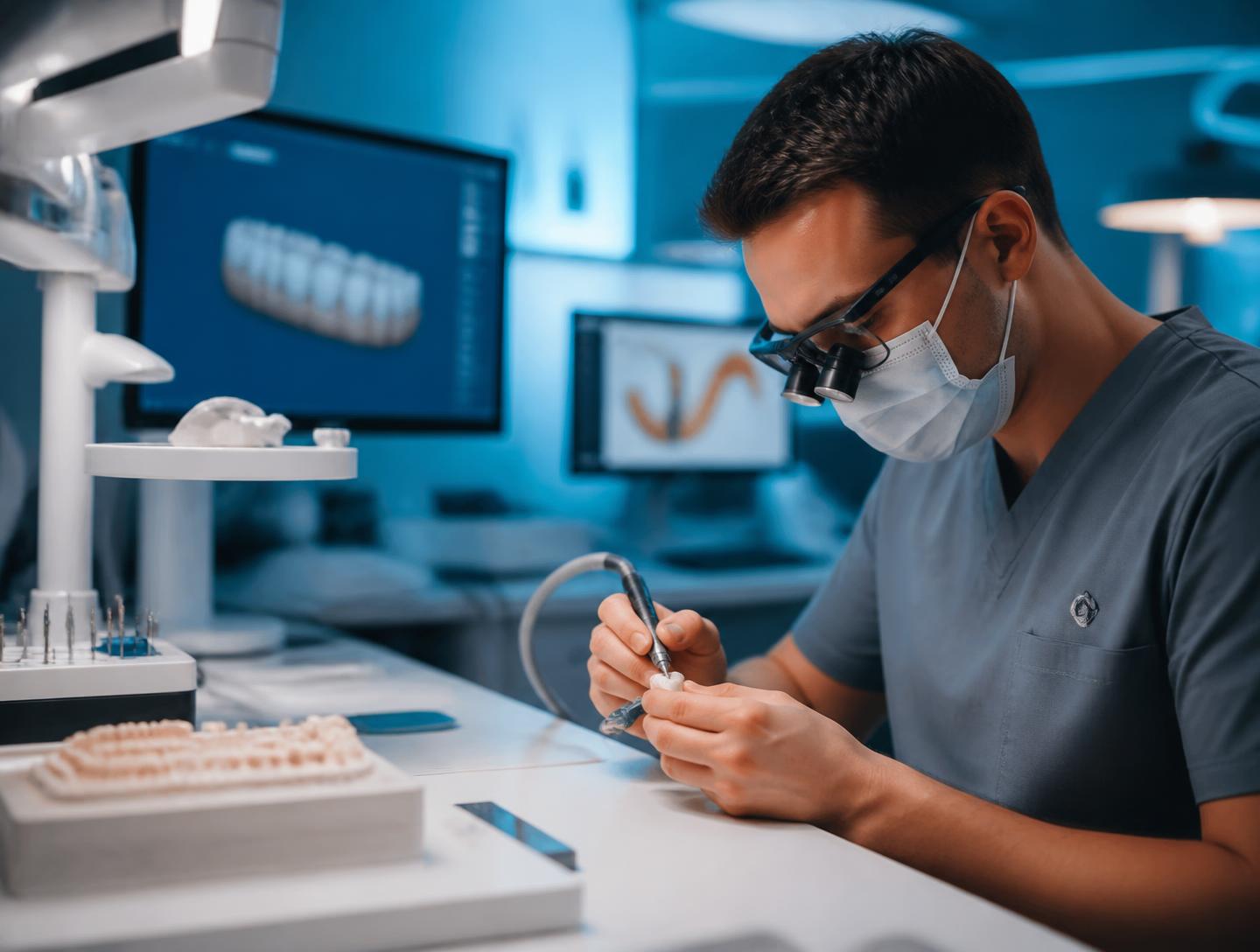
Three-stage QC. Intake check, in-process check, and an independent final QC. The final signoff is done by a QC technician who does not produce cases, so the person who releases the crown is not the person who made it.
workflow-6 — recommended upload 1440 × 960 pixels
Packaging and dispatch. Case ID on the pouch, Rx and composition information with the case, tracking number sent to your case group on dispatch day.

What we check at QC

Final QC covers margin seal and continuity, internal surface (no spurs, voids, or pressure spots), interproximal contact tightness on the master model, static and excursive occlusion, and the metal thickness at functional and non-functional cusps measured with a thickness gauge or micrometer. For every case we can send photographs of the finished crown on the model before shipping — ask once at account setup and it becomes the default for your account.

Internal rework rate across all restoration categories currently runs at 2–3% of production. Trends are reviewed monthly, broken down by product line and root cause, and corrective actions are logged. If you want a monthly on-time, remake, and complaint report for your account, we can produce that for group and DSO clients.

quality-control — recommended upload 1440 × 960 pixels

Compliance, traceability, and audit

Our quality system is covered by ISO 13485. We hold FDA establishment registration and device listing for US-market dental restorations, UK MHRA registration via a UK Responsible Person, and EU MDR custom-device notification (Annex XIII pathway) through an authorized representative. Materials are supplied with CE marking and biocompatibility documentation per the ISO 10993 series.

Case-level traceability is standard. Each case is bound to a unique order number that links the responsible designer, production technician, equipment used, material batch, and QC results. Case records are kept for three months by default; if your compliance program requires longer retention, say so at account setup and we will extend it for your account.

Factory audits are supported. We welcome scheduled on-site visits in Shenzhen and Huizhou, video audits via live stream, and documentation review for quality-system records, material certificates, and process logs.

Pricing structure

We do not publish a flat per-unit retail number for Full Cast Metal Crowns because the final line depends on the alloy class and the design complexity, and quoting an average would be misleading. The structure is:

  • Base price is set by the alloy class ordered (High Noble, Noble, or Predominantly Base).
  • Unit count multiplies that base.
  • Add-ons cover implant-supported components when applicable, custom design complexity (uncommon prep forms, long-span connectors), and composition certification if specifically ordered on a case-by-case basis.
  • Included in the quote: CAD design, model (physical or digital), standard packaging, and standard shipping within our international lanes.

Rush production is available on all case types. For dentist-direct accounts, up to 10 rush cases per calendar month carry no rush surcharge; above that volume, rush is quoted per case. Rush availability is confirmed at Rx stage, not after. Payment accepts bank wire and PayPal; account terms up to 30 days are available after new-account review.

Shipping

We dispatch via DHL, FedEx, UPS, and (for France) SPIDER. Return shipping is covered by Istar above an account-specific case-value threshold. Clearance, duties, broker fees, and remote-area surcharges are on the receiver. Default shipments go without declared insurance; declared value with carrier insurance is available on request and is quoted per shipment.

Turnaround

Case typeIn-lab working days
Standard single-unit Full Cast Metal Crown
2–3
Full Cast Metal Crown bridge (3–4 unit, non-implant)
2–3
Complex implant-retained metal frameworks and full-arch metal substructures
5–7

The clock starts the working day we confirm the case is complete. Design-approval wait, missing Rx fields, and additional information requests do not count against the posted turnaround; the clock resumes when you confirm. Weekends and Chinese public holidays are not counted. International carrier time is additional and is quoted separately.

For digital cases the overall calendar time is shorter because there is no physical-impression transit on the inbound leg. Status notifications are sent at design-complete, production-complete, and dispatch; the dispatch message carries the tracking number.

If a crown comes back with a problem

Report any issue within 24 hours of receipt. The report should include case ID, patient reference, product type, the specific issue, and intraoral or model photos documenting it.

We remake at no additional lab fee for: open margin, open contact, high occlusion, failure to seat, color drift from the Rx, visible cosmetic defect, and poor contour. For a remake, the physical restoration must be returned; digital-only cases can be reproduced from the stored file. Lab-fee-free remake does not cover return shipping or implant components, which are quoted separately.

We do not cover under free remake: customer-initiated changes to color, alloy, or design after the case was approved; cases where the Rx requested production despite a documented poor impression; and cases where a different clinical outcome is being pursued after the restoration was already seated.

Remake priority is 3–5 working days in our schedule. If a remake fails on a second attempt we escalate the case to the production manager and the technical director; if a working outcome still cannot be delivered we offer a credit or a refund rather than a third remake.

MRI, cementation, and food packing — three questions that keep coming back

MRI. A cast metal crown does not contraindicate MRI. The material produces local susceptibility artifact that is generally smaller than ferromagnetic materials, but the imaging team should be told the restoration is present and the alloy composition should be available on request (Hilgenfeld et al., PMC10043623).

Cementation. In a 3,468-crown US practice-based study, 61.9% of single-unit crowns were seated with a non-resin cement (primarily resin-modified glass ionomer) and 38.1% with a resin cement (Makhija et al., PMC6538426). For retentive preps on a cast metal retainer, RMGI is a defensible first choice; short preps or retainer-on-tapered-abutment designs are often better served by a resin cement with a metal primer. Choose per case; we are happy to discuss on complex retainers.

Food packing. Food traps on a seated crown are almost always a contact or marginal-ridge-contour issue, not a material issue. If a patient reports packing after cementation, send us a photo or scan of the seated restoration in situ and we will quote on a reshape or remake depending on the finding.

Working with us

  1. Open an account. Contact our sales team for the current price list and account form. We set up a dedicated WhatsApp or email group per account for case coordination.
  2. Submit a case. Upload the digital files (STL/PLY/OBJ/DCM/3Shape native) or ship the physical impression. The Rx needs clinic, dentist, patient reference, tooth number, alloy tier, due date, and any case notes.
  3. Design approval. Preview arrives in your case group. One design, two free revisions. Approvals and change requests are logged by date.
  4. Production and QC. Status notifications at design-complete, production-complete, and dispatch.
  5. Try-in. Issues reported within 24 hours of receipt are triaged against the remake policy above.

What to send with a Full Cast Metal Crown Rx

  • Tooth number and arch
  • Alloy tier (High Noble / Noble / Predominantly Base) and any Ni-free / Be-free requirement
  • Opposing dentition type (natural, cast metal, PFM, zirconia, denture)
  • Shade for any adjacent restorations if a metal occlusal is being considered
  • Occlusal clearance notes if the prep came back tighter than the window above
  • Whether a composition certificate should ship with the case

FAQ

Which alloys can we actually spec?
High Noble gold-based, platinum-containing high-noble (white, Pd-containing), noble palladium-silver, and predominantly base cobalt-chromium. Composition and lot are documented per case.
Can we request a nickel-free or beryllium-free alloy?
Yes. State the restriction on the Rx and we will select an alloy with no declaration of the restricted element and ship the manufacturer's composition certificate with the case so the absence is documented against the specific lot used. For patients with a confirmed patch-test result for a specific metal, send us the allergen list at Rx stage so we can match the alloy to the clinical requirement.
Do you accept 3Shape, iTero, Medit, Primescan, Dexis, or Shining 3D files?
Yes. We also accept Ori, DS Core, Panda, and WeTransfer uploads. Native 3Shape design files are accepted for CAM-only or CAD review workflows.
What is the minimum occlusal clearance?
1.0 mm non-functional, 1.5 mm functional cusp. For 0.8–1.0 mm clearance we can finish a PFM with a metal occlusal surface as an alternative; a true full-cast still needs the 1.0 mm minimum.
Can a patient have an MRI with the crown in place?
Routinely yes. Inform the imaging team; expect local susceptibility artifact; have the alloy composition available if asked.
Can we visit the factory?
Yes. We host on-site visits in Shenzhen and Huizhou and live video audits for clinics, DSOs, and outsourcing-lab customers.
Do you ever outsource production?
No. Design, milling, casting, porcelain, polish, QC, and packaging are all in-house.
What is the free remake coverage?
Open margin, open contact, high occlusion, failure to seat, color drift from Rx, visible cosmetic defect, and poor contour. Return shipping and implant components are not covered.
Can you support a DSO or a group account?
Yes. One contract can carry multiple clinics with per-clinic case groups, per-clinic billing, and consolidated monthly reports on on-time rate, remake rate, and complaints.

Request a quote for a Full Cast Metal Crown case

Send us the following and we will respond with buildability and a case-specific quote on the next working day:

  • Tooth number(s) and unit count
  • Alloy tier required, and any Ni-free / Be-free requirement
  • Scan file type and intraoral scanner used, or confirmation that a physical VPS impression will be shipped
  • Opposing dentition
  • Target due date (and whether rush is requested)
  • Whether a composition certificate should ship with the case
  • Whether you are a new account

Contact Istar Dental Lab — our sales team confirms account setup, pricing, and buildability. Factory visits (Shenzhen or Huizhou) and video audits can be scheduled with the same contact.

Want to get in touch directly? Reach out to our sales representative via WhatsApp at +8618925410015 for a quick response and a price quote!

References used on this page

  • Mao Z., Beuer F., Hey J., Schmidt F., Sorensen J.A., Prause E. Antagonist enamel tooth wear produced by different dental ceramic systems: a systematic review and network meta-analysis of controlled clinical trials. Journal of Dentistry 142 (2024) 104832. Open the article
  • Makhija S.K. et al. Choice of cement for single-unit crowns in the National Dental PBRN. PMC6538426. Open the article
  • Hilgenfeld T. et al. Artifacts in dental MRI caused by dental materials. PMC10043623. Open the article
  • Khamis A.K. et al. Prevalence of metal allergy in patients with intraoral metallic restorations. PubMed 42106203. Open the record
  • ADA. Materials for Indirect Restorations — three-tier alloy classification. ADA page
  • ISO. ISO 22674 Metallic materials for fixed and removable restorations. ISO page
  • eCFR. 21 CFR 872.3710 — Base metal alloy. eCFR page