
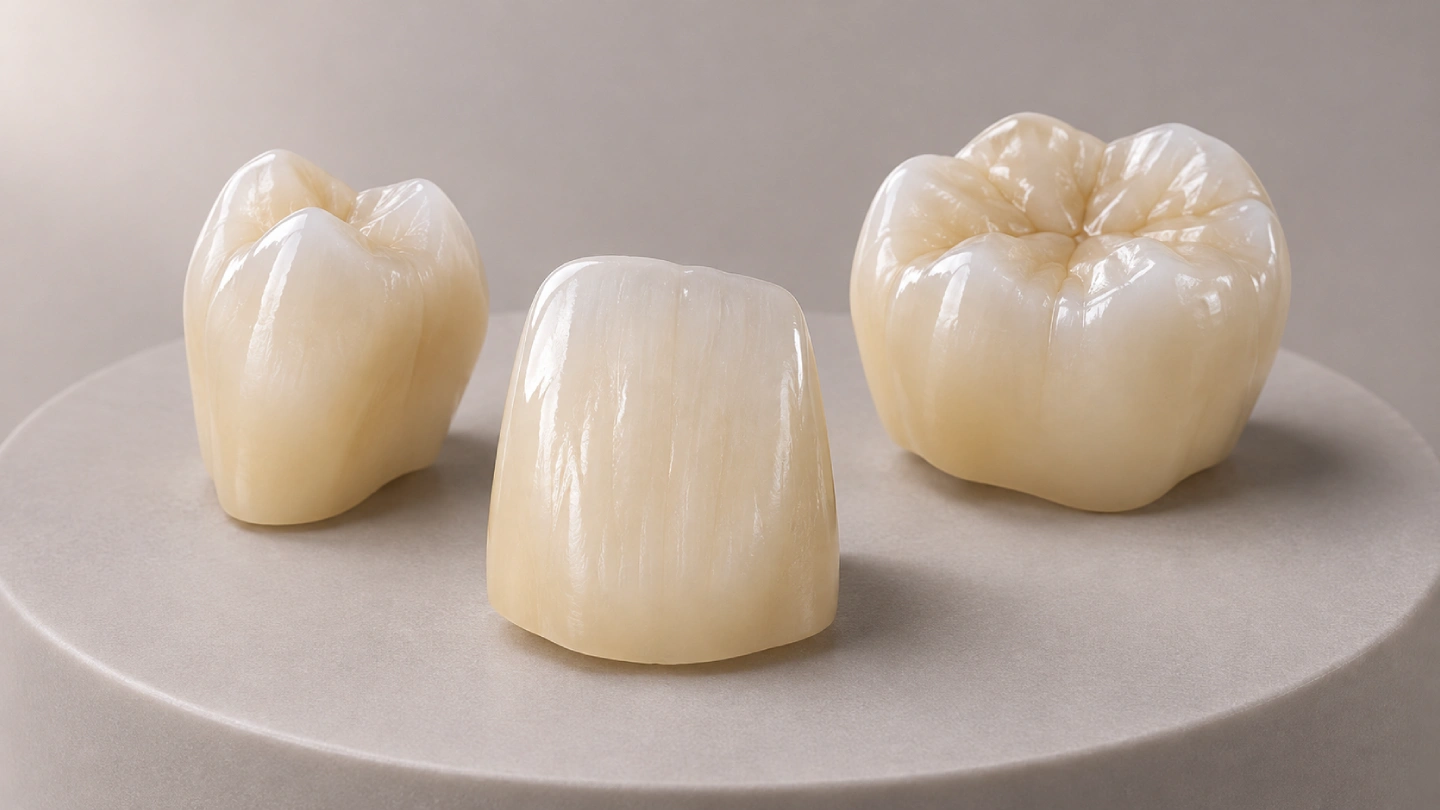
What a multilayer zirconia crown actually is
A multilayer zirconia crown is milled from one zirconia disc whose shade and translucency change along its vertical axis — more chroma near the cervical zone, more translucency toward the incisal edge. Several current systems also change yttria content between layers (typically 3 mol% in the strength-biased zone, 4–5 mol% in the translucency-biased zone), which shifts the mechanical and optical balance within a single restoration. The gradient is pre-pressed into the disc at the material manufacturer; after sintering, the crown is one solid piece.
Three constructions get used interchangeably in casual writing and shouldn’t be:
Term | How the color and strength are built | Where it fails |
|---|---|---|
Multilayer zirconia crown | Built-in color and translucency gradient; milled, sintered, finished as one unit | Bulk fracture at the body or connector if it fails at all; no veneer to chip |
Porcelain-layered (PFZ) crown | Zirconia coping with hand-stacked feldspathic porcelain on the facial | Chipping of the feldspathic layer |
Monolithic solid-shade zirconia | Uniform shade and translucency throughout, no gradient | Flat appearance in the esthetic zone |
Higher translucency travels with lower flexural strength and higher sensitivity to hydrothermal aging. The multilayer construction manages the tension by placing the stronger, less translucent zone where load concentrates and the more translucent zone where the eye lives — the trade-off is distributed, not abolished. For the material-science foundation, Performance of Zirconia for Dental Healthcare and Recent Advances in Dental Zirconia: 15 Years of Material and Processing Evolution cover phase composition and hydrothermal aging in depth.
When this material is the right call
The decision is position-first and risk-first, not material-first:
Scenario | Recommendation |
|---|---|
Anterior single crown, routine occlusion, no parafunction | Multilayer disc in the 4Y–5Y range |
Premolar, moderate load, visible on the smile line | Multilayer 4Y–5Y, with slightly more axial reduction allowance |
Posterior single crown, heavy occlusion | High-strength solid-shade 3Y, or the 3Y layer of a strength-biased multilayer disc |
Documented bruxism or heavy nightguard-worn presentation | 3Y high-strength zirconia; a multilayer disc is possible with increased occlusal thickness and that trade-off settled on the Rx |
Short-span bridge in the esthetic zone | Case-by-case; connector cross-section drives this more than the facial layer does |
Long-span posterior bridge | 3Y high-strength disc, not a multilayer esthetic disc |
Deep subgingival margin planned for conventional cementation | Either tier works; multilayer only if occlusal clearance is honest |
Flag heavy clenching or grinding history on the Rx. A pre-milling exchange on occlusion saves a chairside adjustment later.
Preparation and clearance
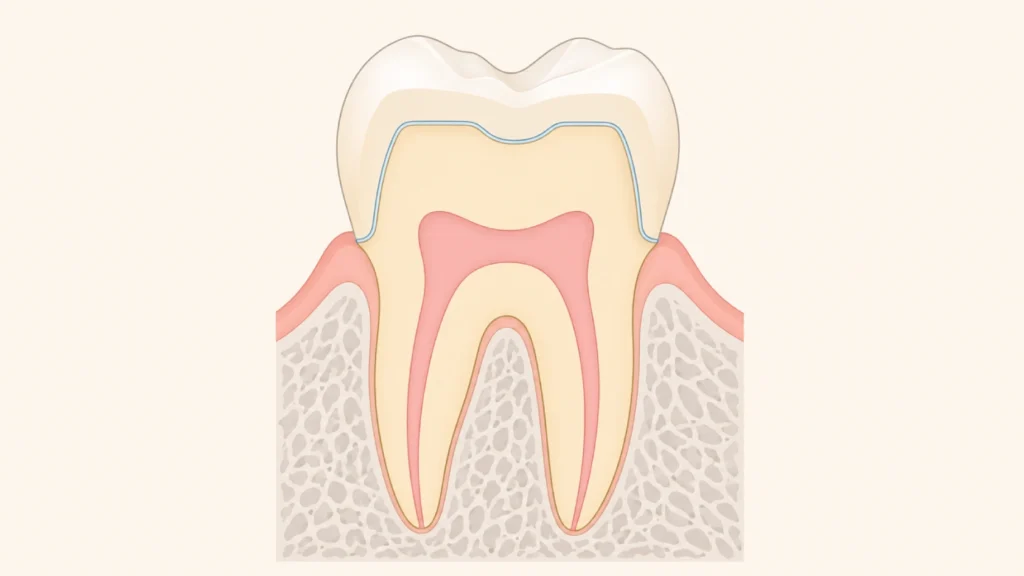
Finished crown thickness and tooth reduction are different numbers. The crown’s wall needs its own thickness; the preparation has to leave at least that much vertical and axial clearance after cement space.
Clinical situation | Minimum finished thickness | Reduction we ask for |
|---|---|---|
Posterior 3Y high-strength zirconia | ~0.5 mm (brand-dependent) | 1.0–1.5 mm occlusal, 0.8–1.0 mm axial |
Posterior multilayer 4Y–5Y | 0.8–1.0 mm | 1.0–1.5 mm occlusal, 0.8–1.0 mm axial |
Anterior monolithic multilayer | 1.0–1.5 mm incisal, 0.8 mm facial | 1.0–1.5 mm incisal, 0.8–1.0 mm facial |
These are working ranges, not brand tolerances. Some products state 0.5 mm minimum; others want 0.7 mm. Name the brand on the Rx and we’ll confirm the exact figure against its current clinical guide — the one we check most often is the Cercon Zirconia Compendium — Clinical Manual.
Mark the finish line by hand in your scanner. Automatic edge detection is reliable on clean margins and drifts on subgingival ones with moisture or soft-tissue impingement; a few seconds spent scribing the margin saves the case.
If occlusal space is tight and you want us to proceed anyway, note occlusal space inadequate — proceed, acknowledge thickness risk on the Rx. That keeps the acknowledgment on paper and keeps your schedule intact.
Shade prescription
Avoidable remakes in multilayer cases cluster around shade more than any other variable. Not because any one step is hard — because missing information gets replaced by assumption, and assumption doesn’t match the chair.
Send five things:
- Target shade on your preferred guide. VITA Classical or 3D-Master — tell us which.
- Stump shade of the preparation, specifically if there’s a discolored dentin core, a cast post, or composite buildup. A thin, translucent restoration will not conceal a dark underlying color, and the final value will shift unless we see it coming.
- A shade photo of the stump next to the tab, taken in indirect light with the tab in the plane of the tooth, before isolation and before the surface dries out.
- One portrait photo at natural distance so we can read the smile line, the incisal edge position of adjacent teeth, and whether the patient has pronounced incisal translucency.
- Written confirmation from the patient on anything that departs from the neighboring tooth’s value — a “lighter than the natural teeth” request belongs on the record. That decides who owns the color conversation at delivery.
Underlying color and crown thickness combine in ways that are measurable rather than intuitive: two studies that quantify the interaction on this material are Effects of Substructure Color and Restoration Thickness on the Final Color of Ultra-Translucent Zirconia Ceramics and Layer-Matched A2 Shade Compatibility Across 3Y/4Y/5Y Multilayer Zirconia. An “A2” rendered in one layer of a given brand will not be the same visual A2 as the same brand’s other layer — borderline esthetic case, send a photograph so the design can account for it.
Chairside adjustment and polishing
Any time a bur touches a sintered multilayer crown, surface damage is introduced. That damage lowers real-world strength, which is a different number from the lab-reported flexural strength. Published data across adjustment, polishing, and glazing lines up: a glaze layer can be worn off; a properly polished surface is the one that stays. See Biaxial flexural strength and surface characterization of multilayer zirconium dioxide after polishing, glazing and clinical adjustments.
Chairside sequence, when adjustment is needed:
- Mark contact and interference with articulating paper. Reduce with a fine-grit diamond, light pressure, water spray.
- Repolish with a zirconia polishing kit through every stage — not the all-in-one single wheel. A two- or three-step rubber system restores a usable surface finish.
- On a heavy-load occlusal surface, a thin new glaze layer over the polished surface functions as a sealing top-coat; it sits on top of polishing, it does not stand in for it.
- Send the crown back if the adjustment went deeper than roughly 0.3 mm or if it broke into the body of the restoration. A pulled-through adjustment on a multilayer can expose a layer boundary and introduce a color shift that polishing won’t resolve.
Cementation
Errors in this step aren’t visible until the crown debonds months later. The protocol below follows Guide to Zirconia Bonding Essentials by John M. Powers.
Protocol
- Clean the fitting surface with a zirconia-specific cleaning paste (ZirClean, Ivoclean, or equivalent) after try-in. Rinse. Dry.
- Air-abrade with 50 µm aluminum oxide at ~1.5 bar at a short, oblique distance. If the restoration ships ready-blasted and sealed, the ticket will tell you.
- Apply an MDP-containing primer or use a resin cement that already carries 10-MDP. That functional monomer forms a stable chemical bond with the fitting surface and is the one chemistry with consistent long-term support in the literature.
- Isolate, seat, polymerize the cement with the curing light per the system’s instructions, remove excess, verify occlusion.
Three ways to undo the protocol
- Hydrofluoric acid etching does nothing useful here. HF works on silica-based ceramics; zirconia has essentially no silica phase. A HF bath leaves the surface clinically unchanged and adds residue.
- Silane alone is not a reliable primer in this chemistry. Silane couples to silica. Combine it with an MDP step, use an MDP-carrying cement, or skip the silane entirely.
- Phosphoric acid used as a pre-cementation clean lowers bond strength. It alters the activated surface in the wrong direction. For saliva contamination during try-in, return to the cleaning paste rather than reach for phosphoric acid.
For a routine prep with retentive geometry, conventional cementation with a resin-modified glass-ionomer is also workable and simpler. Where that’s how a case is designed, the ticket will indicate it.
Our workflow
Istar Dental Lab is a direct manufacturing facility founded in 2012, with production in Shenzhen and Huizhou. Zirconia cases do not leave the facility between departments — intake, design, milling, sintering, finishing, QC, and packaging happen under one roof.
The production file moves through:
- Case intake and completeness check. Missing fields, unclear margins, or an internally inconsistent Rx trigger a pause and a message to the sender — not a guess.
- CAD design on the digital model, with the restoration positioned so the color and translucency zones line up with the vertical level of the preparation.
- Milling.
- Green-state inspection and any pre-sinter refinement.
- Sintering on a locked program — temperature, ramp rate, hold time. Every run is logged, and a new material batch is validated with a test specimen before it enters production.
- Post-sintering shape refinement, staining and glazing where the esthetic brief calls for it, and the full polishing sequence.
- Multi-stage QC: margin, fitting surface, interproximal contacts, occlusion on the model, shade under standardized lighting. For multi-unit cases, color continuity across the batch is verified against the first-piece reference.
- Final inspection, packaging, and traceable records — technician, machine, batch, and QC results are indexed to the case number for retrieval.
The team runs around 460 trained staff across the two facilities, sized so the single-crown throughput absorbs the seasonal jump without stretching commitments.

Standards and registrations
Our active documents cover the lab layer: FDA Establishment Registration, EU MDR notification, UK MHRA registration, and ISO 13485 certification. The material layer sits with the disc producer — the specific 510(k) clearance number for the brand on a given case is available on request. A vendor-file packet with the registration screenshots can be sent whenever a clinic group needs it.
Working with us
- Turnaround. For a single multilayer crown with complete data — scan or impression, clear Rx, shade information — we commit to a working-day target per case at acceptance, rather than publish a generic number. Production plus international shipping varies with destination. For partners whose monthly rush volume stays below about ten units, rush cases carry no additional fee.
- Pricing. Driven by unit count, material tier (3Y versus 4Y–5Y multilayer, specific disc brand), implant componentry where applicable, and design complexity. The tier sheet is shared during onboarding; the invoice already includes design, model, componentry, and shipping.
- Payment. Bank transfer or PayPal. Net-30 terms available on request after the first batch clears.
- Minimums. Solo-clinic accounts have no per-case minimum where the clinic covers shipping. Partner-lab accounts work on a monthly lab fee at or above USD 500.
- Visits. Shenzhen and Huizhou are open for in-person tours. Video audits are available for teams that can’t travel.
FAQ
Does the layer boundary become a weak plane?
When the material is produced and sintered correctly, the interfaces between composition layers are not discrete failure planes. Independent flexural testing on commercial products puts the mid-transition layer between the two outer layers in strength, not below both. The practical risk appears only when a chairside cut carries through from one composition layer into another — the reason the adjustment guidance above draws a line at a deep cut-through.
How is color continuity handled when a patient receives multiple units across separate sessions?
Each unit is designed from the same confirmed shade reference, milled from the same material batch where feasible, and sintered on the same program. For a case where sessions sit months apart, batch assignment is held on the order and a cross-session check against the first-piece reference is run under standardized lighting before shipment.
Does this material wear the opposing enamel more than a solid-shade one?
Current clinical and in-vitro evidence does not show a material-level separation between the two monolithic variants at matched surface state. Wear outcomes are driven far more by surface finish — a fully polished surface is kinder than a glazed-only one, and both are kinder than an adjusted but unpolished surface. The direction of this finding is supported by a published systematic review and meta-analysis on antagonist wear from monolithic zirconia crowns, with the caveat that cross-study heterogeneity is high.
Is a ceramic allergy a realistic concern for the patient?
Zirconium dioxide has an extensive clinical track record of biocompatibility in dental and orthopedic use; genuine hypersensitivity reports are rare. If a documented ceramic allergy is reported, send the workup documentation along with the Rx and we’ll route material selection accordingly.
Do you mill the specific disc a clinician specifies, or only your own stock?
Both. A core set of commonly specified esthetic and strength-tier brands sits on the shelf. Where a clinic has standardized on something outside that set, name it on the Rx and we can source it — a short lead-time note gets added if the supply chain requires one.
What should the clinician check first on an arrived crown before try-in?
Fitting surface, interproximal contacts against the delivered model, margin integrity under magnification, and that the shipped shade matches the one on the ticket. A discrepancy caught before the crown goes near the mouth resolves faster than one caught after cementation.
If you want to send a case
Our sales team walks a new partner through Rx template, scan expectations, logistics, and the tier sheet in one short conversation. A single trial unit against your usual prep type is the normal first step — one case, our standard workflow, no preset.
Scanner-integrated case drop, email, or an intro call — whichever is easiest.